

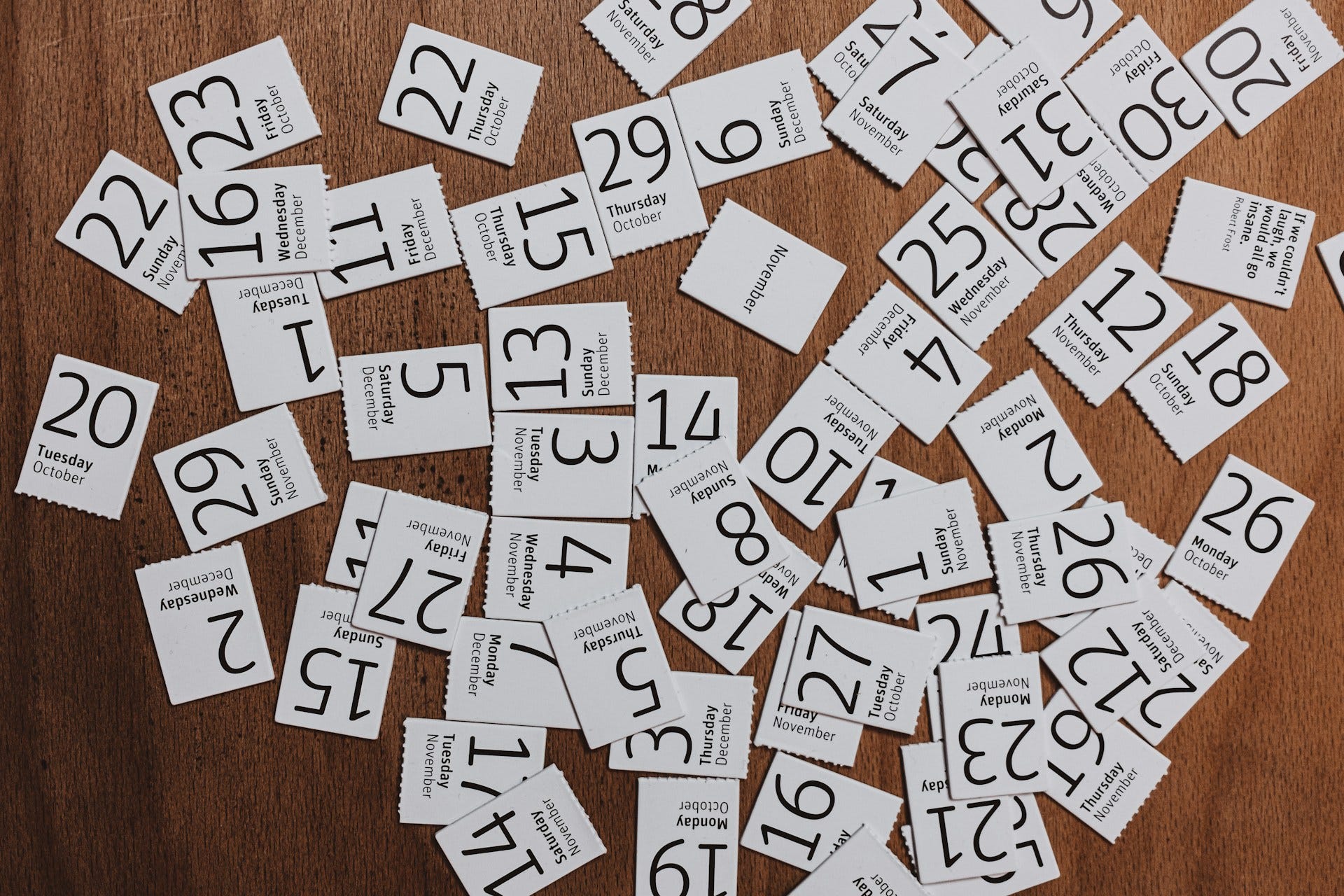
Someone recently asked me what the biggest challenge is for a new community getting started. I didn’t think much about it and was surprised by my own answer: scheduling.
I’ve seen many young groups struggle—or never get off the ground—simply because they can’t get time on the calendar.
The first gathering or call often happens on a wave of initial excitement, but then it gets tricky. The group tries to find a new time over email. Someone sends a long survey with lots of options. Some people respond; some don’t. Before long, it’s clear that none of the options work for everyone. What now? Maybe there’s a second attempt. But chances are another call never happens—or it happens only with a small sub-group. Already, the initial enthusiasm is starting to fade…
For young groups, a consistent rhythm of touch-points is crucial. But many groups never get over the scheduling cliff and, as a result, never develop momentum or consistency.
I see scheduling-related failure particularly among sub-groups within larger networks: eight people want to form a book club; it fades after two meetings. Five members want to form a peer-support circle; they never find a date to get started. The climate working group stays an email chain. These groups are small enough that they need a majority of people to show up—especially at the beginning—so scheduling is crucial.
At its core, the biggest risk of scheduling is that it drains the energy of volunteer leadership. Early community leadership may be energized by the group’s potential, but that motivation is at risk of being worn down by logistics. Early groups depend on the energy of a few people to get things started and keep them consistent, so frustration with scheduling can effectively mean the end of the group.
Here is what I learned about community scheduling:
Don’t try to find the perfect time. Don’t ask people what times work best for them through surveys.
Instead, make a best-guess proposal. I’ve found that if we give people just one choice, the ball is in their court and they often make it work. This shifts the labor onto the group. In contrast, when I send out a survey of possible dates, the onus of finding the perfect date is on me.
Community leaders are often so focused on others that they forget to start with their own needs. A substantial part of community leadership is making sure the group’s gatherings are on the calendar. And yet I’d argue that this responsibility comes with a privilege: you get to choose a time that works well for you.
If your proposal doesn’t work for a majority, make another proposal. Keep it simple, keep it light, keep it fast.
Go ahead if 80% can make it. Don’t try to find a date that works for everyone—it’s an impossible mission.
Once your group has decided on a rhythm (for example monthly), propose a recurring slot. Send out calendar invites for the next 12 months. Adjust along the way if needed.
Schedule as far ahead as possible.
Stick to the date; don’t reschedule. Sometimes, on the morning of a call, several group members will send apologies and someone will suggest finding another date. In my experience, it’s better to stick with the rhythm and hold the call. If this is a recurring call, there will be another one soon.
Whenever possible, use the last part of a call to share a date proposal. It’s much easier for everyone to quickly check their calendars than to do it async over email or chat.
Scheduling in community isn’t trivial. It’s not about finding the perfect date, but about building momentum and a stable rhythm. And it’s about making sure you, as the organizer, don’t frustrate yourself with logistics before you even get started.
What do you think?
Till next time - Fab
About Entangled
// Entangled: We’re exploring and celebrating the people, insights and practices that help purpose-driven communities & networks thrive. If you care about bringing people together, this might be for you.
// Hello, I’m Fab, co-founder of the Together Institute. We work with purpose-driven communities, networks and their leaders to help them thrive.
Thank you for naming this common and important, yet under-discussed challenge, Fabian. Your suggestions make a lot of sense. And I also think there is much more to unpack here...
For some time now, I've been exploring an approach I call "conversation weaving," which offers a different kind of answer to the scheduling conundrum. What if we learned to gather our groups via sets of meetings rather than a single one, harvesting and co-sensing across them? The notion that we must all gather in one place at one time (in person, on a video call, on a single text thread, etc.) strikes me as coming from a mindset we inherited from a world where important things mostly happened via in-person meetings. The hybrid world we inhabit now presents us with many more possibilities, and we have still barely begun to develop patterns of organizing and engaging in dialogue that take advantage of the new reality. The emergence of AI amplifies this potential for process innovation.
I'm not just talking about the idea of scheduling two or three large group calls instead of a single one, but rather a fluid and complex self-organizing system of engagement based on a few simple practices. Among the things that this kind of conversation weaving might make possible are the inclusion of people in many different time zones, the use of multiple languages, mixing of in-person and online gatherings, and the ability to organize around the "micro-contexts" (e.g. the questions you care most about exploring and the people you would prefer to explore them with) that are relevant to you. You can think of it as an expansion of the forms of large group processes like Open Space and World Cafe.
In July, I organized a conversational experiment to explore what a process and tech toolkit for this kind of "hybrid dialogue" might include. I'm overdue to produce a summary of outcomes. We used a Kumu map as a tool for organizing and harvesting, which is password-protected. Add yourself to the map if you want to take a look and also be added to the list for future invitations: https://docs.google.com/forms/d/e/1FAIpQLScfu0A8elcIq7uyzTaZohgDrq7YYE5ma-p8LixSxFFBD3olxw/viewform
Useful tips for organisers Fabian! I think that what comes before "schedulling hell" is a question why a group is engaging in communication and, possibly, shared conversations, decision-making and action.
Why schedulling is needed at all?
I see two aspects of that:
1) Access. It is 'rediculously easy' for organisers or set up some kind of a digital access for and betwen group members. Everyone can access everybody else easily. That's a passive element, provided by community organisers.
However, who pays attention and who is making themseles avilalbe is beyond organiser's control.
2) Availability. Deliberately making ourseleves available, and possibly prioritising staying in asynchronous communication and joining events sychronously is up to every individual, regardless what's the communication channel of choice. That's an active element that no community orgniser can provide, only individual community members can do that -- each for themselves only.
So, why is scheduling needed and is it worth investing time and effort in it? Answers to that question can not be taken for granted.